Pleural Effusion
Chest X-ray finding of fluid around the lungs, often causing blunted costophrenic angles or layered opacity
Pleural effusion is fluid in the pleural space around the lungs and often appears on chest X-ray as blunted angles, layering fluid, or lower-lung whiteness.
Pleural effusion means fluid has collected around the lungs rather than inside the lung tissue. On chest X-ray or CXR, it often shows up at the lung base and may overlap with heart failure, infection, or other causes.
Representative X-ray
Illustrative reference image for this topic.
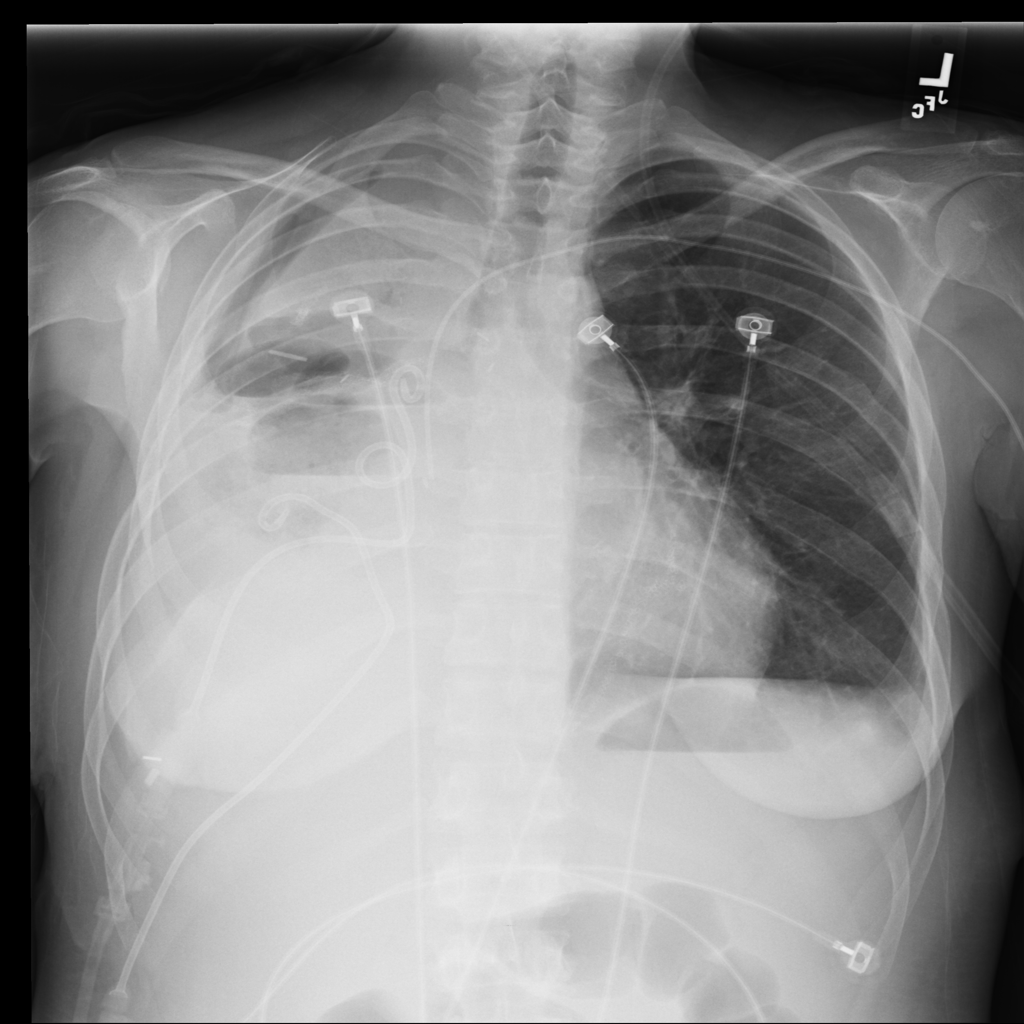
Reference image: PAT-CF38 · IMG-012 · Bounding-box highlight from source annotation where available.
What it is
- Pleural effusion is fluid accumulation within the pleural space
- It is a radiographic finding with many possible underlying causes rather than a single diagnosis by itself
How it appears on chest X-ray
- On chest X-ray, pleural effusion often appears as blunting of the costophrenic angle, a meniscus-shaped white opacity at the lung base, or broader dependent hazy density depending on volume and patient position
What radiologists look for
- Radiologists look for costophrenic angle blunting, meniscus sign, layering fluid, associated atelectatic change, and whether the effusion is unilateral, bilateral, or large enough to shift adjacent structures
How X-ray helps
- Chest X-ray helps show whether pleural fluid is present, which side it is on, and roughly how extensive it looks
- Upright films are usually more helpful than supine portable films, while ultrasound can detect smaller effusions more sensitively
Common causes
- Common causes include heart failure, infection, malignancy, inflammation, renal disease, liver disease, and postoperative or traumatic states
Symptoms / associated symptoms
- Symptoms can include shortness of breath, chest discomfort, cough, or no symptoms at all if the effusion is small
Risk factors
- Risk depends on underlying disease
- Heart failure, pneumonia, cancer, recent surgery, inflammatory disease, and systemic illness can all increase the chance of pleural fluid
Why it can matter clinically
- Larger effusions can worsen breathing, compress adjacent lung, or be associated with infection or other serious underlying illness
When to seek medical care
- New shortness of breath, chest discomfort, fever with pleural fluid, or worsening breathing symptoms should be clinically evaluated
Evaluation and diagnosis
- Evaluation may include chest X-ray, ultrasound, CT in selected cases, and sometimes fluid sampling to clarify the cause
Treatment approaches
Treatment for pleural effusion depends on what is causing the fluid buildup, how large the effusion is, and whether the patient is having symptoms such as shortness of breath, chest discomfort, or fever.
- Management depends on cause and severity
- Observation, treatment of the underlying condition, drainage procedures, and follow-up imaging may all be relevant
- Treatment for pleural effusion depends on what is causing the fluid buildup, how large the effusion is, and whether symptoms such as shortness of breath, chest discomfort, or fever are present
Medication classes clinicians may use
Medication use depends on the underlying cause. For example, diuretics may be used in heart-failure-related effusions, while antibiotics may matter when infection is involved. Not every pleural effusion is treated with medication alone, and drainage may be needed when breathing is affected or infection is suspected.
Treatment modalities commonly paired with medication decisions
- treating the underlying cause
- observation for smaller stable effusions
- thoracentesis in selected cases
- drain placement for larger or complicated effusions
- follow-up imaging
Diuretics
May be used when fluid overload or heart failure contributes to pleural fluid.
- furosemide
- bumetanide
- torsemide
- spironolactone
Antibiotics
May be used when pneumonia or pleural infection is the underlying driver.
- amoxicillin-clavulanate
- azithromycin
- doxycycline
- ceftriaxone
- levofloxacin
Prescription drugs and medications sometimes used
Pleural effusion treatment depends on what is causing the fluid buildup, how large the effusion is, and whether symptoms such as shortness of breath, chest discomfort, or fever are present. Some cases improve when the underlying disease is treated, while others need drainage, antibiotics, diuretics, or closer hospital-based evaluation.
This page is educational only. Medication choice depends on the cause, severity, and clinical setting, and not every pleural effusion is treated with medication alone.
- furosemide
- bumetanide
- torsemide
- spironolactone
- amoxicillin-clavulanate
- azithromycin
- doxycycline
- ceftriaxone
- levofloxacin
- acetaminophen
Examples only: medicines are chosen based on the underlying cause. Heart-failure-related pleural effusions are managed differently from infection-related or malignant effusions.
When antibiotics are used
Antibiotics are not used for every pleural effusion. They are more relevant when the fluid is related to pneumonia, empyema, or another infection.
When pleural effusion is caused by heart failure, malignancy, kidney disease, liver disease, or inflammation, the treatment path is usually different and may rely more on disease-specific management or procedures.
Examples clinicians may consider when infection is involved include amoxicillin-clavulanate, azithromycin, doxycycline, ceftriaxone, or levofloxacin, but the exact choice depends on the organism, care setting, and local guidelines.
When drainage may be needed instead of medication alone
Some pleural effusions are large enough or complex enough that medication alone is not enough. Thoracentesis or chest-drain placement may be needed when breathing is affected, infection is suspected, the diagnosis is unclear, or the fluid returns repeatedly.
Drainage can also help when the care team needs to test the fluid to understand whether the cause is infection, malignancy, inflammation, or another systemic condition.
When pleural effusion needs urgent medical review
Rapidly worsening shortness of breath, chest pain, fever, low oxygen, increasing fatigue, or signs of systemic illness can all justify urgent medical review.
Large effusions, infected pleural fluid, and effusions causing meaningful breathing difficulty may need faster in-person assessment than a small stable effusion found incidentally.
Need help reviewing your own X-ray?
If you landed here because you are trying to understand a chest X-ray result, you can upload an image for an educational review and then use the related finding guides to go deeper.
FAQ
Is pleural effusion the same thing as pneumonia?
No. Pleural effusion is fluid around the lung, while pneumonia is infection within lung tissue.
Can X-ray alone tell what caused a pleural effusion?
No. Imaging can suggest the finding, but the cause often needs clinical and sometimes laboratory evaluation.
Can pleural effusion be treated with medication alone?
Sometimes, but not always. Small or cause-specific effusions may improve when the underlying problem is treated, while larger or complicated effusions may need drainage.
Are antibiotics used for pleural effusion?
Only when infection is part of the picture, such as pneumonia or empyema. Pleural effusions from noninfectious causes follow a different treatment path.
Can pleural effusion be treated with medication alone?
Sometimes, but not always. Small or cause-specific effusions may improve when the underlying problem is treated, while larger or complicated effusions may need drainage.
What drugs are used when pleural effusion is caused by heart failure?
Clinicians often consider diuretics such as furosemide, bumetanide, torsemide, or spironolactone when fluid overload is part of the cause, but the exact regimen depends on the patient.
Are antibiotics used for pleural effusion?
Only when infection is part of the picture, such as pneumonia or empyema. Pleural effusions from noninfectious causes follow a different treatment path.
When does pleural effusion need drainage instead of pills?
Drainage is more likely when the effusion is large, causing meaningful breathing symptoms, recurrent, infected, or when fluid testing is needed to understand the cause.
Can a chest X-ray show whether pleural effusion is infected?
No. X-ray may show pleural fluid, but it cannot reliably prove infection by itself. Clinical evaluation and sometimes fluid sampling are needed.